LANTERN CONDITION & RARITY GRADE SCALE
Understanding Condition and Rarity
When collecting antique lanterns, condition and rarity are two very different things.
A lantern can be in excellent condition but be relatively common. Another lantern may be heavily worn but be extremely rare. Understanding the difference can help collectors make better-informed decisions when buying, selling, and researching lanterns.
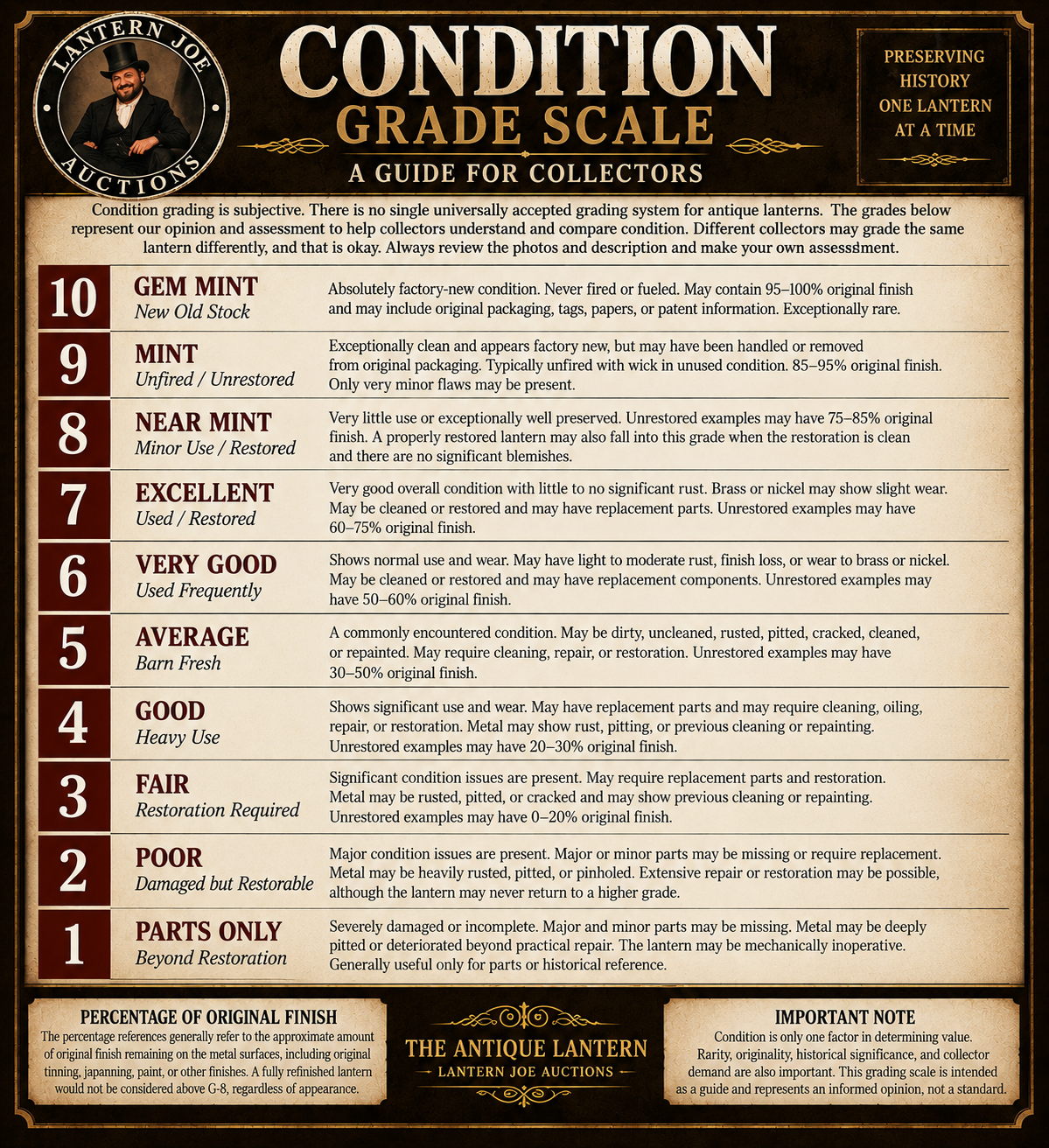
CONDITION GRADE SCALE
A NOTE ABOUT CONDITION GRADING
Condition grading is subjective. There is no single universally accepted grading system for antique lanterns, and different collectors, dealers, and researchers may grade the same lantern differently.
The grades below represent our opinion and assessment of a lantern's overall condition. They are intended as a guide for collectors and should not be considered an absolute or universally recognized standard.
When determining a condition grade, we consider factors such as original finish, wear, rust, pitting, damage, completeness, replacement parts, restoration, and overall appearance.
The photographs and written description of an individual lantern should always be considered along with its assigned grade.
PERCENTAGE OF ORIGINAL FINISH
The percentage references in this scale generally refer to the approximate amount of original finish remaining on the metal surfaces, including original tinning, japanning, paint, or other original finishes.
If a lantern has been completely refinished or has no original finish remaining after restoration, the percentage-of-original-finish portion of the scale does not apply.
A refinished lantern would not be considered above G-8 (Near Mint) regardless of how attractive the restored finish may be.
G-10 — GEM MINT
New Old Stock
Absolutely factory-new condition. Never fired or fueled. May contain approximately 95–100% original finish, tinning, japanning, or paint.
May be found sealed in an original factory crate, box, or bag and may include original tags, papers, or patent information.
This grade is exceptionally rare and may command a significant premium.
G-9 — MINT
Unfired / Unrestored
Exceptionally clean and appears factory new, but has been handled or removed from its original packaging.
Typically unfired and unfueled, with the wick in an unused condition. May contain approximately 85–95% original finish, tinning, japanning, or paint.
Only very minor flaws may be present.
G-8 — NEAR MINT
Minor Use / Restored
Very little use or exceptionally well preserved.
An unrestored example may contain approximately 75–85% original finish, tinning, japanning, or paint.
A properly restored lantern may also fall into this grade when the restoration is exceptionally clean and the lantern has little to no significant blemishing.
G-7 — EXCELLENT
Used / Restored
Very good overall condition with smooth metal and little to no significant rust.
Brass or nickel finishes may show slight wear. May have been cleaned or restored and may contain original-equivalent or replacement components such as globes or burners.
An unrestored example may contain approximately 60–75% original finish.
G-6 — VERY GOOD
Used Frequently
Shows normal use and wear.
May have light to moderate rust, finish loss, or wear to brass or nickel surfaces. May have been cleaned or restored and may contain replacement components.
An unrestored example may contain approximately 50–60% original finish.
G-5 — AVERAGE
Barn Fresh
A commonly encountered condition.
The lantern may be dirty, uncleaned, rusted, pitted, cracked, cleaned, or repainted. It may require cleaning, repair, or restoration.
An unrestored example may contain approximately 30–50% original finish.
G-4 — GOOD
Heavy Use
Shows significant use and wear.
May have replacement parts and may require cleaning, oiling, repair, or additional restoration to become fully operational.
Metal may show rust, pitting, cracking, or previous cleaning or repainting.
An unrestored example may contain approximately 20–30% original finish.
G-3 — FAIR
Restoration Required
Significant condition issues are present.
May require replacement parts and restoration. Metal may be rusted, pitted, or cracked and may show previous cleaning or repainting.
May have issues such as a seeping fount, minor pinholes, or areas requiring new solder.
An unrestored example may contain approximately 0–20% original finish.
G-2 — POOR
Damaged but Restorable
Major condition issues are present.
Major or minor parts may be missing or require replacement. Metal may be heavily rusted, pitted, or pinholed.
Extensive repair or restoration may be possible, although the lantern may never return to a higher condition grade.
G-1 — PARTS ONLY
Beyond Restoration
Severely damaged or incomplete.
Major and minor parts may be missing. Metal may be deeply pitted, cracked, or deteriorated beyond practical repair.
The lantern may be mechanically inoperative or have an irreplaceable cracked or broken globe.
Generally considered useful primarily for parts or historical reference.
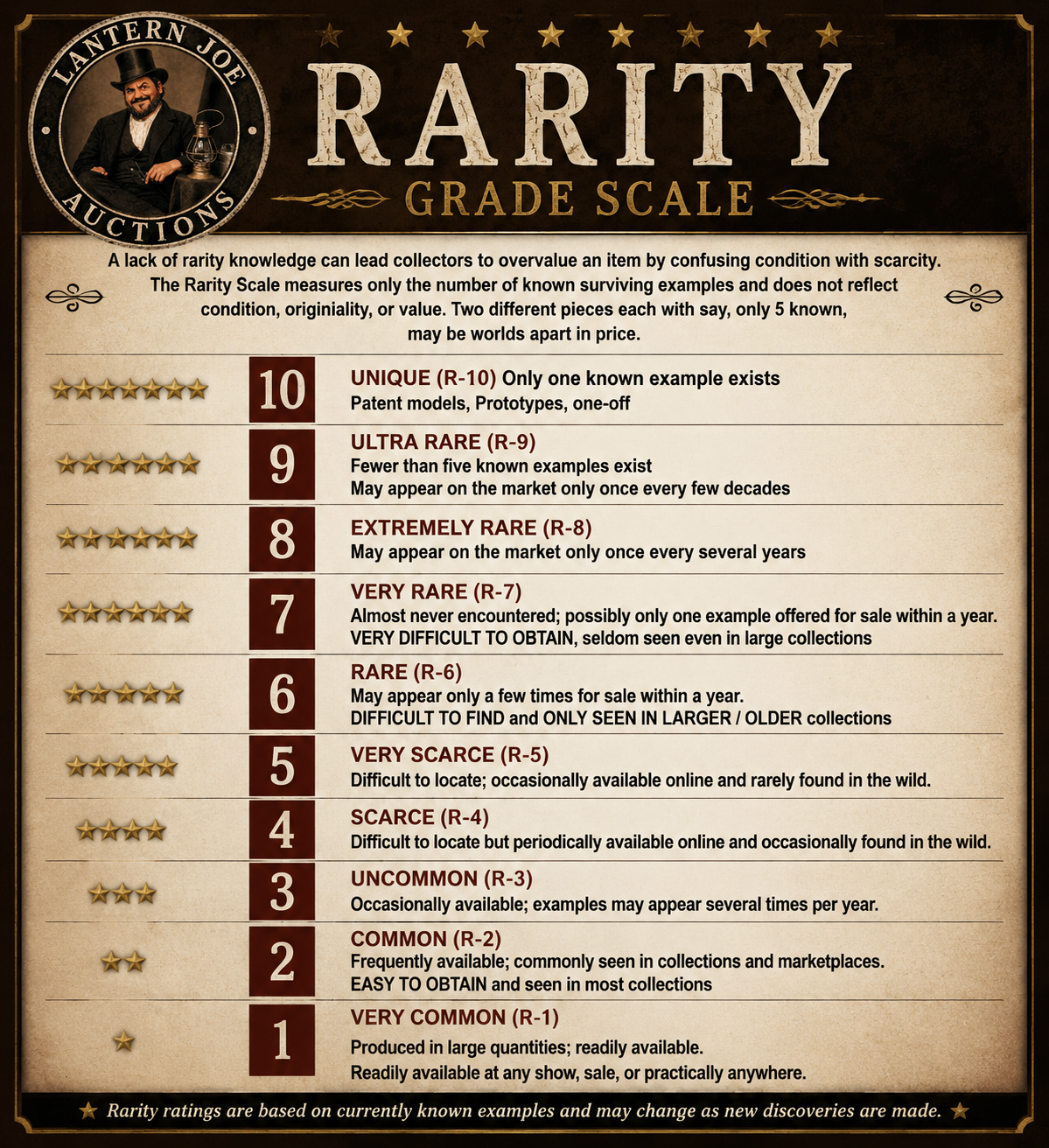
⭐ RARITY GRADE SCALE
A NOTE ABOUT RARITY
Rarity is not the same as condition.
Our Rarity Scale is based on the number of known surviving examples of a particular lantern, model, variation, or configuration.
The scale does not determine condition, originality, desirability, or monetary value.
Two different lanterns could each have only five known examples and still be worlds apart in price because of differences in condition, historical importance, demand, originality, or other factors.
Rarity ratings are based on currently known examples and may change as new discoveries are made.
R-10 — UNIQUE
Only one known example
Patent models, prototypes, and one-of-a-kind examples.
R-9 — ULTRA RARE
Fewer than five known examples
May appear on the market only once every few decades.
R-8 — EXTREMELY RARE
Very few known examples
May appear on the market only once every several years.
R-7 — VERY RARE
Almost never encountered
Possibly only one example offered for sale within a year. Very difficult to obtain and seldom seen even in large collections.
R-6 — RARE
Very difficult to find
May appear for sale only a few times within a year. Typically seen only in larger or older collections.
R-5 — VERY SCARCE
Difficult to locate
Occasionally available online and rarely encountered in the wild.
R-4 — SCARCE
Difficult to locate
Periodically available online and occasionally found in the wild.
R-3 — UNCOMMON
Occasionally available
Examples may appear several times per year.
R-2 — COMMON
Frequently available
Commonly seen in collections and marketplaces. Relatively easy to obtain.
R-1 — VERY COMMON
Readily available
Produced in large quantities and commonly encountered at shows, sales, auctions, and in collections.
CONDITION & RARITY ARE SEPARATE
A G-10 lantern is not necessarily rarer than a G-3 lantern, and an R-10 lantern is not necessarily more valuable than an R-3 lantern.
Condition describes the state of the individual lantern.
Rarity describes how scarce the lantern or variation appears to be based on currently known surviving examples.
Both can be important when evaluating a collectible, but they should always be considered separately.
A FINAL NOTE
These grades are intended as a collector's guide and represent an informed opinion, not an absolute standard.
As new information, examples, discoveries, and research become available, rarity assessments may change, and reasonable collectors may sometimes disagree about a condition grade.
The goal of this scale is to provide collectors with a consistent reference point while encouraging everyone to examine each lantern for themselves.